arXiv preprint, October 2026

A zero-shot object navigation framework that draws topological exploration memory directly onto the egocentric route choices a VLM selects from.

  • Jincheng Wang1
  • Chi Pui Chan1
  • Wei Zeng2
  • Shuyang Zhang3
  • Jianhao Jiao2*
  • Dimitrios Kanoulas1
  • 1University College London
  • 2China Merchants Group, LionRock AI Lab
  • 3Shenzhen University
  • *Corresponding author
Read the paper PDF Code, coming soon
Play in 3D
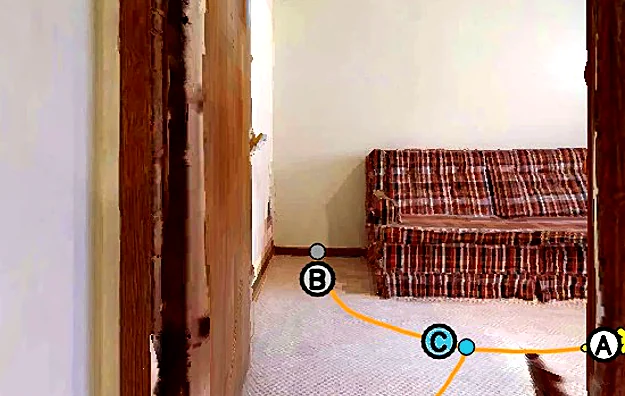
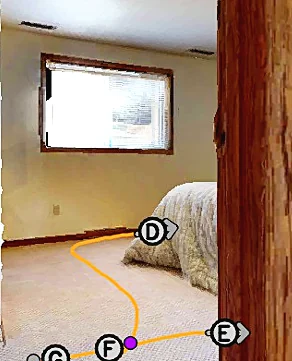
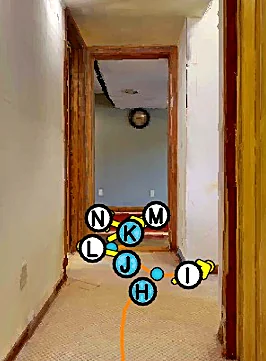
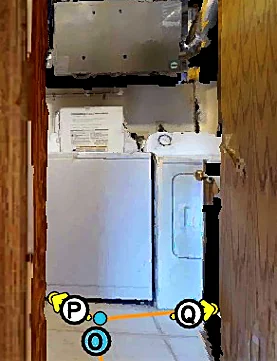
Illustration, recorded from the interactive 3D version

Watch the full runs5 videos

81.2%success rate, HM3D v0.2
42.5%SPL, HM3D v0.2
7.5%of WMNav’s VLM calls, same VLM

State of the art on HM3D, without policy training. Competitive on MP3D and tested on a Unitree Go2, indoors and out.

Overview

Memory the VLM can see

Many zero-shot navigation methods let a VLM judge promising directions from the camera view, but keep what has been explored somewhere else, as text or a map. MarvisNav keeps a topological graph of the search and projects its candidate nodes, together with their exploration states, onto the egocentric views.

AbstractRead the full abstract

When searching for an object, people choose their next move by considering both likely target locations and places already explored. The current view can cue place-associated memories, bringing target relevance and prior exploration into the same spatial context. In many zero-shot object navigation (ZSON) methods, however, vision-language models (VLMs) infer promising search areas from egocentric images, but exploration history enters the decision through separate representations, e.g., as text or maps. This separation either requires an additional fusion step to align semantic evidence with exploration state, or leaves the correspondence between memory and route choices implicit for the VLM to recover. We instead make exploration memory visible directly on visual route choice. We propose MarvisNav, a ZSON framework that maintains a topological graph and projects candidate nodes together with their exploration states onto the egocentric perception as memory-bearing visual route choices. These topological states capture local exploration progress beyond binary visitation. By binding exploration state directly to each visual candidate, MarvisNav enables the VLM to jointly evaluate target relevance and exploration state and make the final high-level selection without a separate post-hoc fusion or reranking stage. Without policy training, MarvisNav achieves state-of-the-art performance on HM3D (81.2% SR and 42.5% SPL), while competitive on MP3D. Moreover, it outperforms representative VLM-based methods with far fewer VLM calls (e.g., 7.5% of WMNav). Real-robot experiments across diverse scenes further validate its practical deployability. Beyond MarvisNav, our study shows that memory representation shapes VLM decisions and ZSON performance, highlighting that effective memory use in ZSON depends not only on its availability, but also on how it is represented.
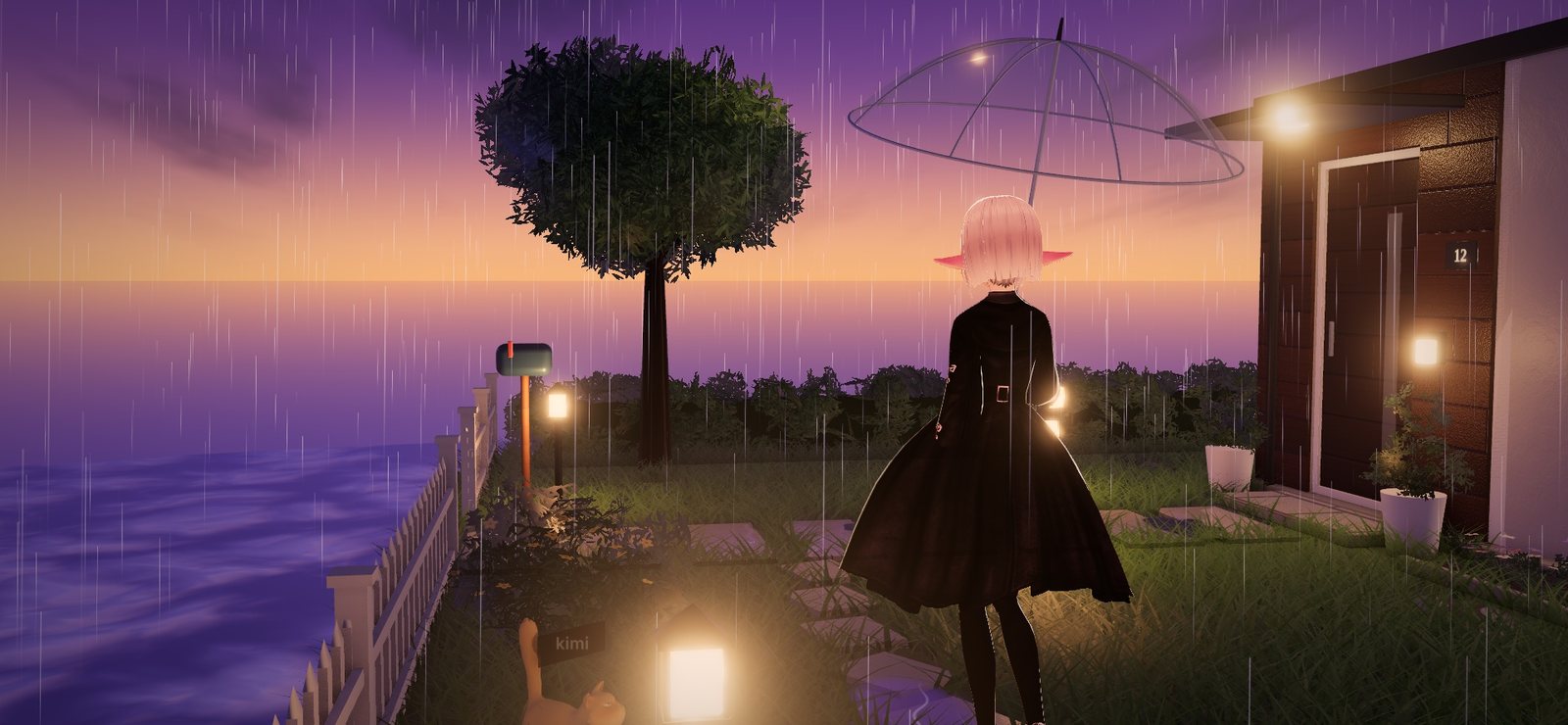
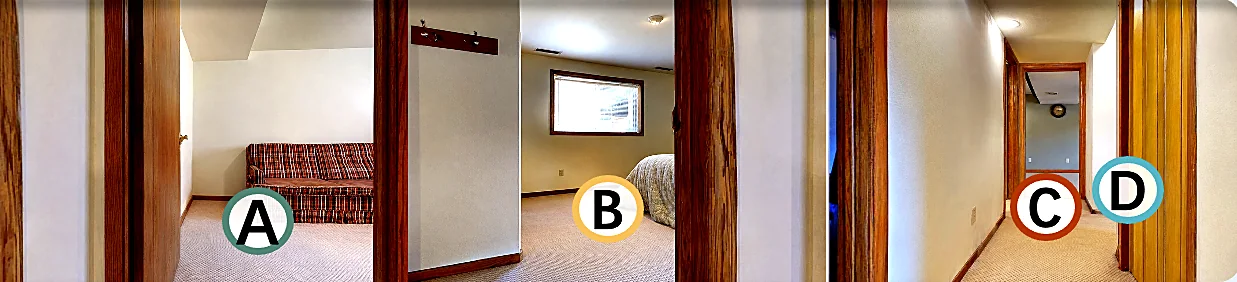
Figure 1. Object search asks a VLM both where the target might be and which areas have been searched. Left: with separate representations, memory either changes the VLM’s preference from outside or leaves the VLM to infer which memory goes with which choice. Right: MarvisNav grounds topological exploration memory on the egocentric route choices, so target relevance and exploration state are judged together, and the chosen route is directly a navigation goal.

Why it matters

Same view, different memory

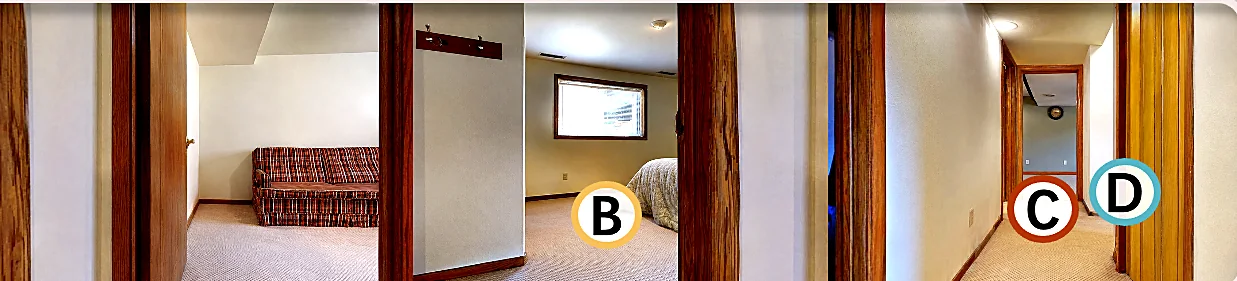
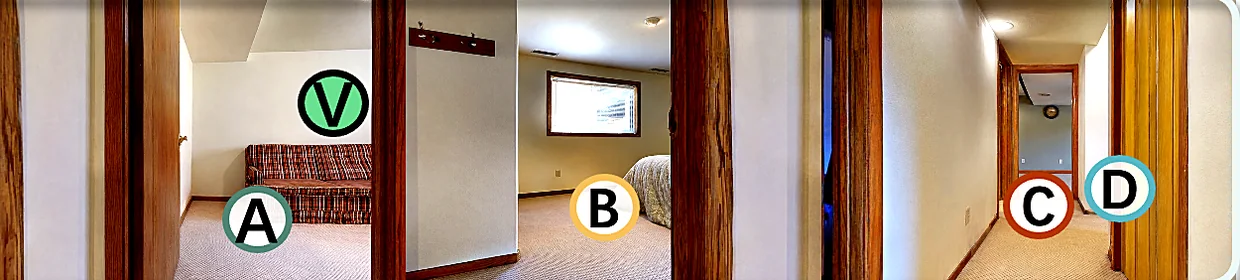
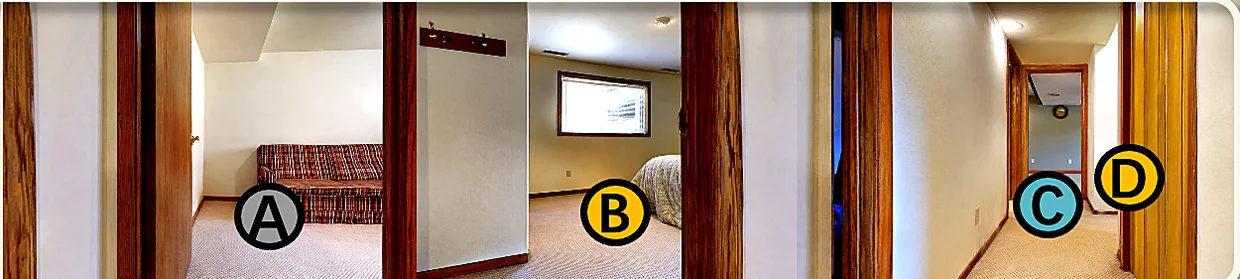
A controlled test from the paper: the scene, the target (a chair) and the four candidate routes stay fixed, and only the way exploration memory reaches the VLM changes. Route A leads to a room that has already been searched.

Target chair

Three egocentric views with four candidate routes marked A, B, C and D, all drawn the same way. The same views with route A removed; only B, C and D are marked. The same views with a separate green V marker beside route A. The same views with each marker filled in its exploration state: A grey, B and D yellow, C cyan.

No memory. The VLM sees the four routes and nothing about what has been searched. A post-filter takes these same scores and drops A only afterwards.Pre-filter. The searched route A is taken out of the view before the VLM is asked.Text history. The same view as without memory, plus a text summary of the previous step, which describes the room just searched.Visited marker. A separate V marker is drawn beside route A; the route markers themselves stay as they were.Choice-aligned state. Each route marker carries its own exploration state: A is an explored endpoint (grey), B and D are unexplored endpoints (yellow), and C is an open junction (cyan).

Gemini 3.5 Flash

Qwen3.5-Plus

route A, already searchedother routesscore 0 to 10, higher means more worth exploring; mean of 10 runs

Both models score the searched route A highest. A post-filter can only remove it after the fact and fall back on the rest of this ranking, without reconsidering the other routes.Removing A changes how the other routes are ranked: Gemini’s top choice moves from B to C, and Qwen’s from C to B. The candidate set itself sways the VLM.Qwen still scores the searched A above the unvisited D (2.30 against 1.67): the history does not reliably turn into the intended route preference.Gemini still scores A above the unvisited D, and Qwen’s scores vary widely from run to run; on average it even ranks A first. Marker and route remain two things to match up.Both models clearly set the searched route A apart, and Qwen scores it 0. With the state on the choice it belongs to, there is nothing left to match up.

And in navigation

MarvisNav on HM3D v0.2 with Gemini 3.5 Flash; only the memory cue changes.

  1. No memorycolours carry no state71.935.4
  2. Post-filteringdropped after the VLM74.337.1
  3. Pre-filteringdropped before the VLM75.037.2
  4. Textual historylast 10 visits as text73.636.6
  5. Visited markersmarkers beside routes76.540.6
  6. Choice-aligned (ours)state on each route81.242.5

Method

How it works

Three steps, repeated at every junction until the target is found. One VLM query per decision.

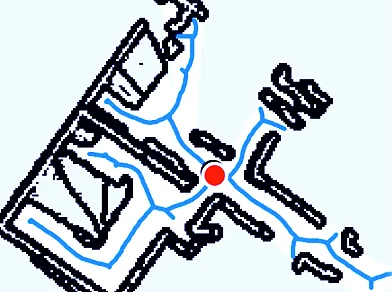
Keep a state-aware graph

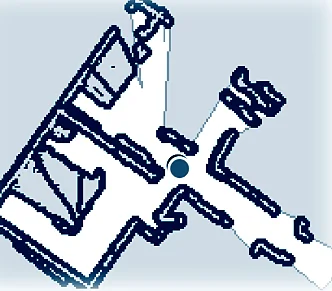
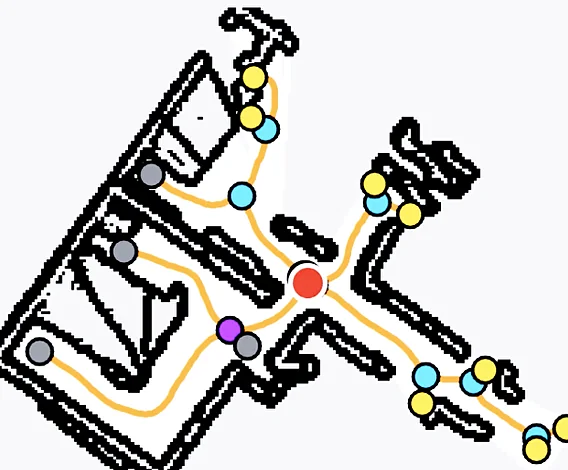
As it moves, the robot maps the free space and skeletonises it into a reduced Voronoi graph: junctions are the places to decide, paths are the routes between them. Every node gets one of four exploration states from its frontiers and neighbours, because a visited junction can still open onto unexplored space.

  • unexplored endpoint
  • explored endpoint
  • open junction
  • explored junction

Draw it on the view

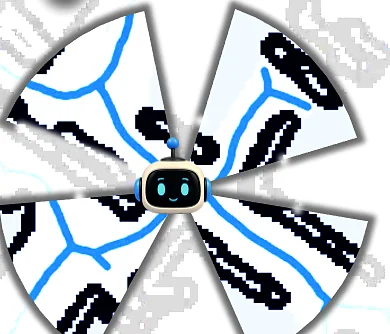
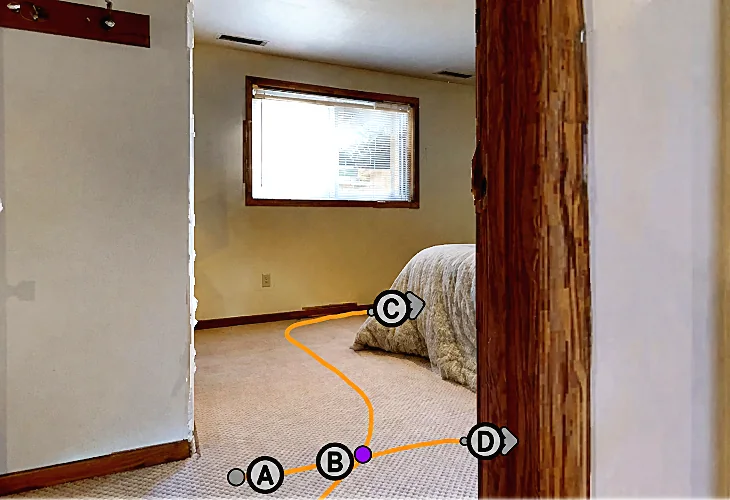
At a junction the robot looks only towards the routes that matter, here four views. Visible paths and candidate nodes are projected into each view, and every candidate gets a letter and the colour of its state: memory-bearing visual route choices.

Let the VLM choose

Given the target, here a couch, a single VLM query weighs how relevant each route is against how much is left to explore, and answers with a letter, here C. The letter is a graph node, so it becomes the next goal for the planner. No fusion or reranking step follows.

Videos

See it run

One full run in simulation, then four on a real robot. Every search starts from an empty map and only the name of its target, with no human help.

In simulation

Shown at twice its speed.

Find a fire extinguisherIn an office building, from the task to the goal. The search took 3 min 55 s and stops 0.81 m from the extinguisher, inside the 1.5 m success radius.

32.0mtravelled
164.6m²mapped
7decisions
7VLM queries

In the real world

On a Unitree Go2, each shown at three times its speed.

Find a toiletIndoors. The search took 1 min 50 s.

14.2mtravelled
111.1m²mapped
3decisions
3VLM queries

Find a potted plantIn the reception of a large office: the run shown in Figure 5 of the paper. The search took 4 min 36 s.

39.2mtravelled
238.6m²mapped
9decisions
9VLM queries

Find a benchOutdoors, in a garden. The search took 5 min 34 s.

42.2mtravelled
304.3m²mapped
11decisions
11VLM queries

Find a personAt home: the person is out on the balcony. The search took 2 min 47 s.

18.1mtravelled
140.8m²mapped
6decisions
6VLM queries

Film

MarvisNav in six minutes

The method, the results and the four real-robot searches in one narrated film, with music.

The narrated filmSound on. The chapters below jump to each part.

Results

State of the art on HM3D

Success rate (SR) and success weighted by path length (SPL) under the standard ObjectNav protocol, on 5,195 validation episodes across HM3D v0.1, HM3D v0.2 and MP3D. MarvisNav trains no policy.

sorted by SRbest in column

MethodSR (%)SPL (%)
MarvisNav (ours)VLM
81.2
42.5
OpenFrontierVLM
77.3
35.6
ApexNavembedding
76.2
38.0
Uni-NaVidtrained policy
73.7
37.1
DRIVE-NavVLM
72.4
41.3
WMNavVLM
72.2
33.3
RememNavVLM
67.8
36.6
VLFMembedding
63.6
32.5
InstructNavVLM
58.0
20.9
SG-NavLLM
49.6
25.5
L3MVNLLM
36.3
15.7

Table 1 of the paper. Zero-shot unless marked as a trained policy. Results come from the original papers; where those lack a benchmark, from the reproductions reported by ApexNav (HM3D v0.2: L3MVN, VLFM, SG-Nav; MP3D: L3MVN, OpenFMNav). On HM3D v0.1 MarvisNav has the highest SR with SPL close to the best; on MP3D it is competitive but not ahead on every metric.

Fewer VLM calls, better results

Same 1,000 HM3D v0.2 episodes, all with Gemini 2.5 Flash.

  1. WMNav54,515SR 71.8SPL 32.4
  2. OpenFrontier22,752SR 73.3SPL 35.6
  3. MarvisNav ours4,115SR 78.5SPL 40.07.5% of WMNav’s calls, 18.1% of OpenFrontier’s

MarvisNav asks the VLM only at junctions, once per decision. With Gemini 3.5 Flash it needs 3,926 calls for the same episodes and reaches 81.2% SR.

Across VLMs

HM3D v0.2, rest of MarvisNav fixed.

  1. Qwen3-VL-8B76.038.3
  2. Qwen3.5-9B76.537.8
  3. Qwen3.7-plus77.339.3
  4. Gemma4-26B78.938.5
  5. Gemini 2.5 Flash78.540.0
  6. Gemini 3.5 Flash81.242.5

Even with the light Qwen3-VL-8B, MarvisNav reaches 76.0% SR. Under the same Gemini 2.5 Flash it beats WMNav and OpenFrontier, so the gain is not the VLM alone.

BibTeX

Cite this work

@article{wang2026marvisnav,  title   = {MarvisNav: Making Memory Visible on Route Choices for Zero-Shot Object Navigation},  author  = {Wang, Jincheng and Chan, Chi Pui and Zeng, Wei and Zhang, Shuyang and Jiao, Jianhao and Kanoulas, Dimitrios},  journal = {arXiv preprint arXiv:2610.06510},  year    = {2026}}